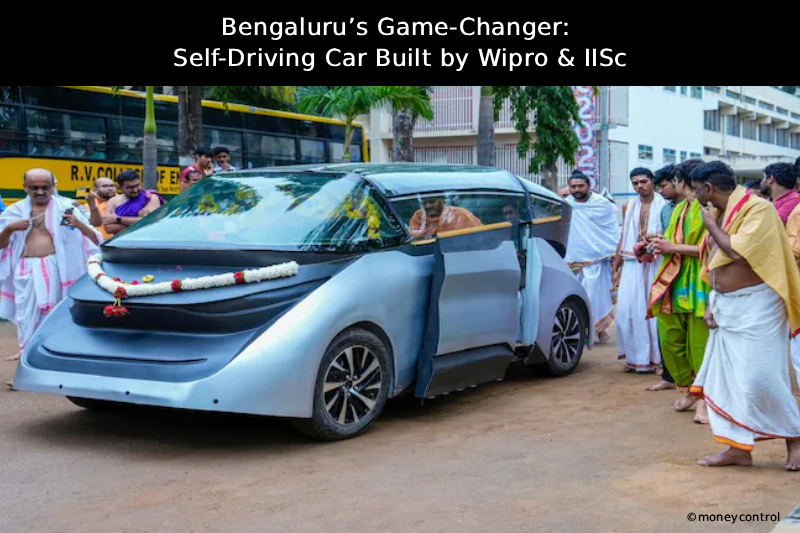
Imagine gliding through Bengaluru’s busy roads, potholes and all, in a car that drives itself. Sounds like sci-fi? Well, it just got real. In a bold step forward, Wipro Limited, Indian Institute of Science (IISc) and RV College of Engineering have unveiled a driverless car in Bengaluru — designed, tested and ready to challenge the ordinary. This could be a watershed moment for Indian roads.
What’s the deal with this driverless car?
Collaboration at its best
- Wipro and IISc joined hands in 2019 to form the joint research unit called the WIRIN (Wipro-IISc Research and Innovation Network). Wipro
- RV College factors in to bring in engineering talent and on-ground debugging, making this prototype uniquely suited for Indian conditions.
- Together they’ve created a car that isn’t just “autonomous” in a sandbox — it’s built for real roads, real traffic, real unpredictability.
Why Bengaluru?
You might ask: why choose Bengaluru? Well, this city has the mix of chaos and technology that makes it a perfect test-bed: potholes, mixed traffic, unpredictable pedestrians — it’s the kind of place where an ordinary autonomous car might struggle. But that’s exactly what makes success here meaningful.
Highlights of the prototype
- Engineered for Indian terrain and traffic dynamics (yes, cows on the road, sudden stops, narrow lanes)
- V2X (Vehicle-to-Everything) communication capabilities & autonomous sensors — courtesy of WIRIN’s research focus. Wipro
- A tangible demonstration – not just slides on a screen, but an actual vehicle unveiled in Bengaluru.
Why this matters
1. A leap for mobility in India
Self-driving cars have been tested extensively overseas, but India’s roads are a different beast. This development signals that Indian researchers and companies are stepping up to those unique challenges.
2. Impacts on safety & traffic
Imagine fewer road accidents, smoother commutes, maybe even less stress from dealing with jammed traffic and crazy lanes. A reliable autonomous vehicle tailored for India could bring that closer.
3. Tech ecosystem boost
Wipro, IISc, RV College: this trio shows that industry + academia + engineering colleges = powerful combo. This will likely spin off new jobs, fresh startups, and innovation in transportation systems, AI, robotics and beyond.
Challenges ahead
Even with this big step, there are real hurdles.
- Regulation & law: are our laws ready for driverless cars on Indian public roads?
- Infrastructure: the roads, traffic signals, connectivity need to support autonomous tech in a robust way.
- Trust & adoption: will drivers and passengers feel safe? Will the system handle edge-cases (monsoon floods, unmarked lanes)?
- Cost: For India to benefit widely, the tech must come down in cost — accessible, not just luxury.
A peek at the future
Let’s think ahead. If this prototype scales up:
- Shared autonomous shuttles in tech parks or smart cities.
- Last-mile autonomous vehicles for campuses or gated communities.
- Integration with 5G and smart-city infrastructure to weave in these vehicles seamlessly.
- More Indian research labs joining the ecosystem, making this “Made in India” mobility real.
Why you should care
You might say: “Okay, neat idea, but what does it mean for me?”
- If you commute in Bengaluru (or any major Indian city), smarter mobility could mean less time wasted, more comfort.
- If you’re in tech, education or startups, this is a signal: Indian mobility and autonomous systems are opening up.
- As a citizen, this matters: safer roads, possibly less congestion, more innovation — all good for quality of life.
Conclusion
The unveiling of this driverless car in Bengaluru isn’t just a flashy press-event — it’s a marker. A marker that says: Indian roads, Indian challenges, Indian talent. We’ve got what it takes. It’ll still take time, tweaks, trust gaining — but the ball is rolling.
So next time you’re stuck in traffic, imagine: maybe soon, you’ll look around, hand off the wheel, relax and let the car navigate the chaos. That future isn’t far.
🏁 Want to keep an eye on this? Bookmark it, share it — the era of autonomous vehicles in India is shifting gears.