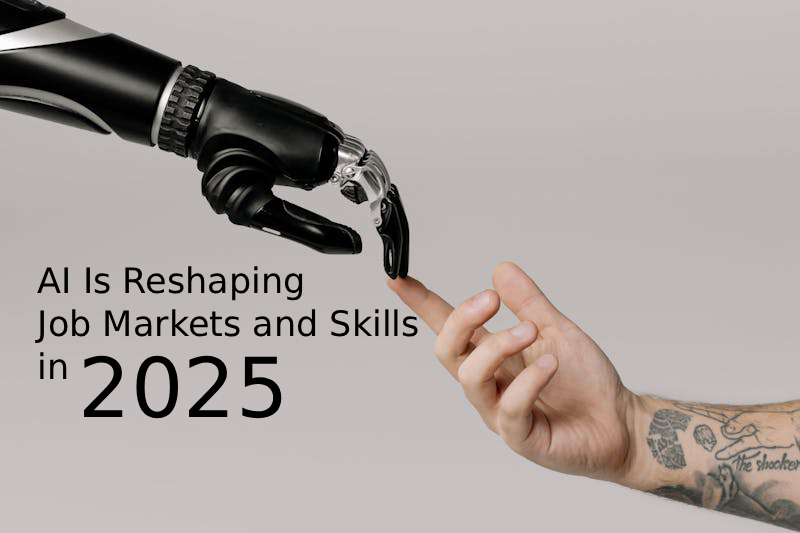
Remember when artificial intelligence sounded like something out of a sci-fi movie? Fast-forward to 2025, and it’s now the quiet co-worker sitting beside you — writing code, managing data, and even helping make business decisions.
But let’s be real: AI isn’t just changing how we work — it’s reshaping who gets hired, what skills matter, and which jobs are here to stay. From office cubicles to creative studios, the ripple effect of AI is everywhere. The question isn’t “Will AI take my job?” anymore — it’s “How can I evolve with it?”
The Great Shift: AI and the Modern Workforce
AI isn’t about replacing humans — it’s about redefining roles. Automation has stepped into repetitive, data-heavy tasks, freeing humans to focus on creativity, strategy, and emotional intelligence.
🏭 Industries most impacted
- Manufacturing: Predictive maintenance, robotics, and supply-chain optimization have made operations faster and safer.
- Healthcare: AI-powered diagnostics and virtual assistants are reducing workload for doctors and improving accuracy.
- Finance: Fraud detection, risk analysis, and automated investing are now standard.
- Marketing & Content: Tools like ChatGPT and Jasper are speeding up ideation, while still relying on human nuance for storytelling.
- Education: Personalized AI tutors are helping students learn at their own pace — redefining the role of teachers as mentors, not just lecturers.
So, AI isn’t killing jobs — it’s reshaping them. But it’s also changing what employers look for.
The Skills That Matter in 2025
If you want to stay future-proof, it’s less about learning to “beat AI” and more about learning to work with it.
1. Digital fluency
You don’t have to be a programmer, but you do need to understand how digital tools, analytics, and automation systems function.
2. Prompting and critical thinking
AI can generate answers — but only if you ask the right questions. The ability to craft effective prompts, interpret results, and think critically is becoming gold.
3. Emotional intelligence (EQ)
While AI can mimic empathy, it can’t feel it. Managers, leaders, and customer-facing professionals with high EQ are becoming invaluable.
4. Adaptability and learning agility
Tech changes every few months. The employees who thrive are those who constantly upskill, reskill, and stay curious.
5. Ethical and responsible AI use
As AI influences hiring, lending, and healthcare, understanding the ethical implications of algorithms is crucial. Businesses want professionals who use AI wisely, not blindly.
New Job Roles Emerging in 2025
AI isn’t just modifying old jobs — it’s creating new ones that didn’t exist a few years ago:
- AI Trainer / Prompt Engineer – people who teach AI models and refine their accuracy.
- Data Ethicist – ensuring algorithms are fair, unbiased, and transparent.
- Automation Consultant – helping companies adopt AI without losing the human touch.
- Human-AI Interaction Designer – crafting interfaces that feel natural and intuitive.
- Cybersecurity Analyst (AI-driven) – using AI to predict and prevent digital threats.
Just like the internet once gave birth to web developers and social media managers, AI is building a whole new generation of roles.
The Flip Side: Challenges We Can’t Ignore
Of course, not all that glitters is gold. AI’s rise brings its own set of hurdles.
⚠️ Job displacement
Some roles — especially in customer service, data entry, and manufacturing — are shrinking. The key is transition, not panic. Governments and companies must invest in retraining programs.
⚖️ Inequality of access
AI tools aren’t distributed equally. Smaller businesses or developing countries may lag behind in adoption, widening economic divides.
🧠 Mental health & identity shifts
When machines take over certain tasks, people can feel “replaceable.” It’s vital to reframe AI as an assistant, not a rival. Human creativity, empathy, and ethics still define meaningful work.
How You Can Stay Ahead
Here’s how to keep your career relevant in this AI-powered landscape:
- Upskill regularly: Learn AI-related tools in your field — from chatbots to data visualization.
- Follow trusted platforms: Coursera, edX, and LinkedIn Learning now offer AI-integrated courses across industries.
- Network with purpose: Join online communities, AI forums, and local tech meetups.
- Stay curious: Read about how AI is affecting your domain — not just tech.
Because here’s the truth: adaptability beats automation every single time.
The Takeaway
AI isn’t stealing the future — it’s shaping it. The job market of 2025 belongs to those who combine technology with humanity. Machines can process, but only humans can create meaning.
So, instead of fearing AI, learn to dance with it. The future of work isn’t man vs. machine — it’s man with machine. And those who master that partnership will define the next era of success.
👉 Read more – World Economic Forum – Future of Jobs Report 2025